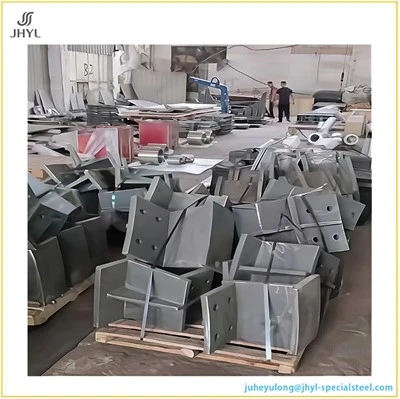
Alloy Steel Casting Components and ordinary carbon steel castings are both commonly used metal casting products in industrial machinery manufacturing. They are mainly produced through casting processes to form the required mechanical components. Although their manufacturing methods share certain similarities, differences in chemical composition result in variations in microstructure, mechanical properties, operating characteristics, and application ranges.
First, their material compositions are different. Ordinary carbon steel castings are primarily based on iron and carbon, with certain amounts of elements such as silicon and manganese. Their properties are mainly influenced by carbon content and other related chemical components. Alloy Steel Casting Components, on the other hand, are produced by adding one or more alloying elements to steel. Common alloying elements include chromium, manganese, nickel, molybdenum, and vanadium. These elements influence the material's microstructure and properties, helping it meet different industrial application requirements.
Second, their mechanical properties differ. Ordinary carbon steel castings have a well-established history of industrial use and are widely applied in general mechanical structures and load-bearing components. Alloy Steel Casting Components can achieve improved strength, toughness, hardness, and hardenability through appropriate alloy composition and heat treatment. This makes them more suitable for certain working environments that require higher overall mechanical performance.
Third, their wear resistance may differ. Ordinary carbon steel castings can meet the requirements of many general working environments. However, their wear resistance may be limited when components are exposed to continuous friction or abrasive materials for extended periods. Certain alloy steels can achieve improved hardness and wear resistance through the addition of elements such as chromium and manganese, combined with suitable heat treatment. Therefore, they are commonly used in crushers, mining machinery, and other industrial equipment operating under demanding wear conditions.
Fourth, their impact resistance depends on material composition and heat treatment conditions. Ordinary carbon steel castings can achieve suitable toughness through appropriate material selection and process control, making them suitable for many general mechanical applications. Alloy Steel Casting Components can achieve an improved balance of strength and toughness through the appropriate combination of elements such as nickel and manganese, together with suitable heat treatment. This makes certain alloy steel castings suitable for applications involving repeated impact and complex loading conditions.
Fifth, their responses to heat treatment are different. Ordinary carbon steel castings can undergo heat treatment processes such as annealing and normalizing to improve their microstructure and mechanical properties. Alloy Steel Casting Components contain different alloying elements, which may result in more complex heat treatment behavior and microstructural transformations. Depending on the material type, suitable heat treatment methods can be selected to achieve the required performance.
Overall, the fundamental difference between Alloy Steel Casting Components and ordinary carbon steel castings lies in their chemical composition and the resulting material properties. Alloy steel castings can meet a wider range of specialized operating requirements through alloying and process control, while ordinary carbon steel castings are suitable for many conventional mechanical manufacturing applications.