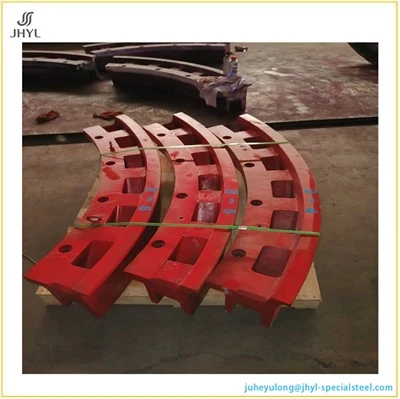
The wear resistance of the High-chromium Alloy Clad Hammer Head serves as its core advantage and the most prominent performance feature that distinguishes it from conventional hammer heads. Its overall wear performance ranks at the medium-to-high end among crushing wear parts, making it perfectly suited for various high-intensity and high-loss crushing operation scenarios. Traditional crusher hammer heads, such as manganese steel hammer heads and ordinary cast iron hammer heads, suffer rapid surface loss when subjected to continuous impact and abrasive erosion from hard materials. After short operating hours, they develop surface abrasion, profile deformation and dents on the striking face. These defects not only compromise crushing performance but also force frequent shutdowns for component replacement, which severely hinders the production efficiency of the whole line. The High-chromium Alloy Clad Hammer Head adopts a differentiated composite structural design. The wear-prone striking working surface is manufactured from high-chromium alloy, while the base body uses tougher steel material for integration. It combines exceptional wear resistance and impact toughness, solving the long-standing dilemma of conventional hammer heads which are either wear-resistant yet fragile against impacts or impact-resistant yet prone to fast wear.
The high-chromium alloy material contains a high proportion of chromium elements and is produced through specialized smelting processes. The finished material features high density and sufficient hardness, with strong resistance to abrasive wear and impact wear. In scenarios such as sand and stone crushing, ore processing and solid waste treatment, materials continuously strike, rub against and scour the hammer head surface. Ordinary hammer heads experience substantial daily wear, whereas the alloy working surface of the High-chromium Alloy Clad Hammer Head can effectively resist cutting and abrasion from material particles. Its surface wears at a greatly reduced rate, and it rarely suffers peeling, chipping or severe wear deformation. Even when processing hard granite, basalt, iron ore, or construction waste mixed with sand and impurities for extended periods, it maintains stable wear performance.
In practical applications, under identical working conditions and material types, the service life of the High-chromium Alloy Clad Hammer Head is 2 to 3 times that of ordinary manganese steel hammer heads and more than 3 times that of cast iron hammer heads. Many sand and aggregate plants and building material processors that switch to this hammer head see an immediate drop in replacement frequency for wear parts. Conventional hammer heads may need replacement every few days or a week, while the High-chromium Alloy Clad Hammer Head can operate stably for dozens of days or longer. This drastically cuts downtime and maintenance caused by worn components.
Meanwhile, the hammer head delivers uniform wear resistance. It avoids localized rapid wear during operation and retains its overall profile for an extended time to guarantee stable crushing performance. Its wear resistance will not decline rapidly even under full-load continuous operation, making it ideal for non-stop assembly line production. It both lowers the cost for wear part replacement and improves the operational efficiency of the entire crushing line, making it a cost-effective preferred component for high-consumption crushing applications.