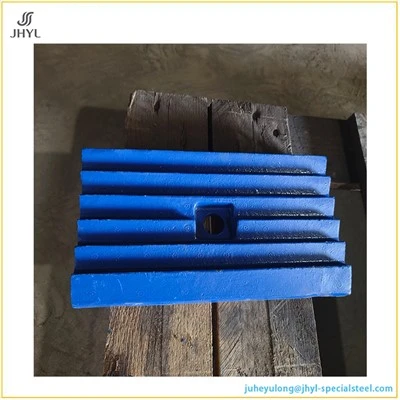
No professional testing instruments are required for procurement and acceptance of Wear Resistant Alloy Steel Castings. Product quality can be accurately assessed via four intuitive dimensions: surface details, weight density, tapping sound and operational performance. This helps users distinguish premium authentic products from inferior defective goods, avoiding procurement risks, frequent equipment failures and substandard service life. Although many low-cost inferior castings appear visually similar, their internal materials, manufacturing processes and performance differ drastically, easily leading to rapid abrasion, fracture, rust and short service life after installation. Mastering intuitive quality identification methods is extremely important.
Surface and craftsmanship inspection serves as the most fundamental and intuitive evaluation standard. High-quality Wear Resistant Alloy Steel Castings adopt sophisticated production processes, with regular overall shapes, clear outlines and full, neat corners free of deformation, warping or missing sections. Their finely processed surfaces are flat and smooth, free of excessive pores, sand holes, shrinkage cavities, slag inclusions, cold shuts, cracks, burrs and flash, with a clean overall finish and no secondary polishing or repair traces. In contrast, inferior castings are produced with crude, simplified processes and loose casting control, resulting in rough, uneven surfaces covered with tiny pores and sand holes, incomplete corners and excessive burrs. Some even carry obvious cracks and repair marks. Such castings have loose internal material structures and are highly prone to damage and failure during operation.
Weight and density verification is another core judgment indicator. For castings of identical specifications and dimensions, high-quality Wear Resistant Alloy Steel Castings use standard alloy formulas and sufficient casting feedstock, with dense internal materials, solid weight and a substantial hand feel rather than a light hollow sensation, which proves full casting without internal cavities or loose structures. To cut costs, inferior manufacturers reduce the dosage of high-grade alloy raw materials, cut casting feedstock and simplify production processes, resulting in loose internal structures and internal cavities. Their weight is noticeably lighter than standard products of the same size, with substandard material density that comprehensively weakens abrasion resistance, impact resistance and corrosion resistance, drastically shortening service life.
Tapping sound detection is a simple, effective auxiliary inspection method. Gently tap the solid section of the casting with a hard object. High-quality Wear Resistant Alloy Steel Castings produce a clear, loud, long-lasting uniform echo, proving dense internal structures with no hidden cracks or cavities and stable material performance. Inferior castings emit dull, turbid sounds without clear echoes or even abnormal noises, indicating loose internal materials, hidden cracks or cavities. They tend to crack and damage under impact and long-term abrasion and count as unqualified defective products.
Operational performance verification is the most practical evaluation criterion. After installation, high-quality Wear Resistant Alloy Steel Castings wear evenly and slowly, resisting rapid wall thinning, peeling and cracking during long-term continuous operation. They rarely rust in humid, acid-base environments, delivering stable operation and low failure rates. Inferior castings wear rapidly with severe local loss, developing obvious scratches, indentations, cracks and rust after short-term operation and requiring frequent shutdowns for replacement. In conclusion, qualified high-quality Wear Resistant Alloy Steel Castings feature regular appearance, solid weight, clear tapping sound and stable operational performance.