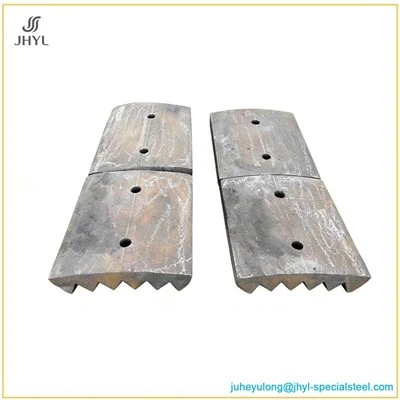
Products Description
This is not a standard CrMo hammer head. It is a dual-metal composite engineered for forging and crushing operations where conventional tool steel fails prematurely.
We forge the body from 42CrMo alloy steel (AISI 4140 equivalent) to retain a continuous metal flow line, then apply a tungsten carbide (WC) hardfacing layer to the primary impact and wear zones using a controlled robotic weld overlay process.
The result is a hammer head that absorbs heavy forging blows without cracking, while the WC layer resists the abrasive wear that destroys standard CrMo heads in weeks rather than months.
- What this means for your operation: fewer change-outs, less unplanned downtime, and a measurable reduction in cost per ton - the only number that matters in heavy forging and crushing.
Core Material
Forged 42CrMo Alloy Steel
Forged - not cast - with a ratio of ≥ 3.0, giving a continuous grain flow that absorbs high-energy impact without spalling or fatigue cracking. Quenched and tempered to HRC 28–32 for the optimal toughness/hardness balance.
Wear Layer
Tungsten Carbide Hardfacing
Applied in 6–12 mm thickness only to the impact face and abrasive sliding zones. At HRC 62–66, it is harder than the materials it encounters in service - granite, basalt, clinker, and sinter.
Technical Specifications
Full material and dimensional data. Custom grades and hardfacing coverage available on request.
| Parameter | CrMo Alloy Substrate (Core) | Tungsten Carbide Overlay |
| Material Grade | 42CrMo / AISI 4140 | WC + Cr + Mo alloy |
| Hardness | HRC 28–32 (Q&T) / HRC 50–55 (surface-hardened option) | HRC 62–66 |
| Impact Toughness | ≥ 40 J/cm² | - |
| Chemical Composition | C: 0.38–0.45%, Cr: 0.90–1.20%, Mo: 0.15–0.25% | WC: 60–70%, Cr: 4–6%, Mo: 1–2% |
| Hardfacing Thickness | - | 6–12 mm (customizable per wear zone) |
| Forging Ratio | ≥ 3.0 | - |
| Weight Tolerance | ±2% (rotor balancing available) | - |
| Dimensional Tolerance | ±0.02 mm (machined mounting surfaces) | - |
Note on grades: 42CrMo is the standard specification. We also produce in 35CrMo, 5CrMo16KU, and custom CrMo grades per customer drawings. Send your drawing or model number for grade confirmation.
Why WC-Hardfaced CrMo Beats Standard Forging Hammer Heads
Five engineering reasons that show up on your maintenance log, not just on a spec sheet.
The fundamental problem with conventional forging hammer heads is the trade-off between toughness and wear resistance. Harder steel cracks under repeated impact; tougher steel wears away too fast.
We solve this with two materials doing two jobs:
- The 42CrMo core is forged (not cast) to retain continuous grain flow, giving it the impact toughness to absorb high-energy forging blows without spalling or cracking.
- The tungsten carbide overlay takes the abrasive punishment - the gouging, sliding, and cutting wear that degrades the working face. At HRC 62–66, it is harder than the abrasive materials it encounters.
The upfront cost of WC carbide hammer heads is higher than that of standard CrMo hammer heads. The calculation that really matters is cost per ton of processed material, not the unit purchase price.
- Service life is 3 times longer compared with standard 6Cr-1Mo Q&T hammer heads.
- Reduce annual replacement labor costs.
- Reduce unplanned downtime and spare parts inventory.
Cast CrMo hammer heads are cheaper to produce but have lower density and no directional grain flow. Under repeated forging impact, cast heads develop fatigue cracks that propagate from internal porosity.
Our heads are forged with a ratio of ≥ 3.0, which closes internal porosity and aligns the grain structure along the direction of load. This directly improves fatigue resistance - the failure mode that causes most premature hammer head replacement in forging service.
A hammer head that doesn't fit precisely creates vibration, uneven wear, and premature failure of adjacent components. Every mounting surface on our heads is CNC machined to ±0.02 mm, with weight tolerance of ±2% for rotor balance. Dynamic balancing reports are available for multi-station hammer assemblies.
WC overlay is expensive. Applying it uniformly across the entire head wastes material on zones that don't experience wear. We map the wear pattern of your specific application and apply 6–12 mm of hardfacing only where it matters - the impact face and any zones that experience abrasive sliding contact. This reduces cost while extending life where it counts.
Applications
Engineered for the most abrasive forging and crushing environments.
Forging
Equipment:Pneumatic & drop forging hammers
Materials:CrMo steel billets, alloy steel forgings
01
Mining & Quarrying
Equipment:Primary & secondary impact crushers
Materials:Granite, basalt, quartz, iron ore
02
Cement
Equipment:Clinker crushers, raw material prep
Materials:Limestone, clinker, coal
03
Metallurgy
Equipment:Coke & sinter crushing lines
Materials:Coke, sinter, slag
04
Construction Aggregate
Equipment:Hard rock impact crushers
Materials:Hard rock, recycled concrete
05
Ordering Information
| MOQ | 1 piece (sample orders accepted) |
| Customization | Fully customizable to drawing / model |
| Lead Time | 7–15 days standard / 20–30 days custom |
| Packaging | Wooden case, seaworthy packing |
| Shipping | DHL / UPS / FedEx / Air / Sea |
| Payment Terms | T/T, L/C - negotiable for repeat orders |
| Warranty | Guaranteed against manufacturing defects |
To quote accurately, we need:
- Equipment make and model (or mounting dimensions)
- Material being processed (hardness and abrasiveness)
- Current hammer head life (hours or tons per head)
- Drawing or sample - preferred, but we can work from measurements

Hot Tags: high-chromium alloy clad hammer head, China high-chromium alloy clad hammer head manufacturers, suppliers, factory, Ball Mill Liners, crusher components, crusher parts, High Chromium Cast Iron Wear Resistant Liner Board, High Manganese Steel Wear Resistant Liner Board, High Mn Steel Crusher Hammer