Products Description
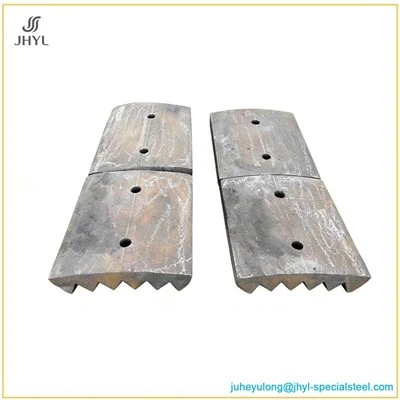
High Manganese Steel Jaw Plate is a core wear-resistant component for jaw crushers, fabricated from high-manganese austenitic steel with a manganese content of 11% to 14%. It is classified into fixed jaw plates and movable jaw plates. It directly contacts ore feed and bears extrusion, impact and crushing loads. This material features unique work-hardening properties: the surface quickly hardens upon impact and friction from feed materials, while the inner matrix retains toughness to resist fracture. It is suitable for crushing medium-to-high hardness materials including granite, iron ore and construction demolition waste, with a standard operating temperature range of -20°C to 60°C. Its wear service life far exceeds that of ordinary cast iron plates, making it the mainstream liner component for mine crushing equipment.
Product Advantages
High Impact Resistance
Leveraging the inherent properties of high manganese steel base material, it rapidly forms a hardened layer under high-frequency impact loads and withstands heavy compression without easy fracture.
01
Superior Wear Resistance
The working surface gradually hardens during operation, significantly extending effective single-unit service life while maintaining the high toughness of the overall matrix.
02
Wide Application Compatibility
It fits all mainstream jaw crusher models available on the market and can directly replace old jaw plates without complex equipment modification.
03
Convenient Replacement
The integral structure perfectly matches the original equipment mounting positions, streamlining disassembly and assembly procedures and greatly shortening equipment downtime for component replacement.
04
Low Comprehensive Operating Cost
Longer service life and fewer replacement cycles effectively reduce long-term spare part consumption and maintenance downtime for crushing production lines.
05
Product Image


Working Principle
High Manganese Steel Jaw Plate relies on the reciprocating motion of the movable jaw to generate compressive force. It exerts sustained squeezing and bending stress on feed materials entering the crushing chamber to break large lumps into small pieces that meet target particle size requirements. Under continuous material impact, a high-hardness wear-resistant layer gradually forms on the jaw plate surface. While preserving the high toughness of the internal matrix, this layer continuously resists material abrasion loss and maintains stable crushing operation efficiency.
Manufacturing Technology
Integrated One-Piece Casting
Integrated one-time casting technology is adopted to achieve a uniform and dense internal metallurgical structure, free from porosity, sand holes and other defects that compromise structural strength.
Water Toughening Heat Treatment
All products undergo proprietary water toughening thermal processing to obtain a stable austenitic matrix microstructure, drastically boosting overall toughness and impact resistance.
Working Tooth Surface Reinforcement
Targeted strengthening treatment is applied to the working tooth surfaces to further enhance surface wear resistance and slow tooth profile abrasion and deformation.
Precision Finishing Machining
Fine machining is performed on the mounting mating surfaces to guarantee flatness, enabling tighter fitting between the jaw plate and equipment for evenly distributed stress.
Relevant Data
| Material Grade | Manganese Content (%) | Working Condition | Typical Application |
| Mn13 (ZGMn13) | 11–14 | Low to medium hardness materials, moderate impact | Limestone, coal gangue, soft sandstone |
| Mn13Cr2 | 12–14 + 1.5–2% Cr | Medium abrasiveness materials | River pebbles, iron ore, medium hardness rocks |
| Mn18Cr2 | 17–20 + 1.8–2.5% Cr | Highly abrasive hard rock | Granite, basalt, quartzite |
| Mn22Cr2 | 21–23 + 2% Cr | Extreme abrasive conditions | Iron ore, quartz stone, ultra-high hardness rock |
FAQ
Q: What daily maintenance practices can extend the service life of High Manganese Steel Jaw Plate?
A: Clear stone residue adhered to the plate body after each shift to eliminate persistent friction from embedded hard debris. Regularly inspect surface wear levels and adjust feeding methods to reduce violent impact.
Q: Is there a large disparity in jaw plate wear rates when crushing different stone materials?
A: The difference is quite noticeable. Hard, sharp-edged stone accelerates surface abrasion, while softer, rounded feed materials cause far milder plate wear and deliver longer service cycles.
Q: What operational factors cause abnormal noise from High Manganese Steel Jaw Plate during crushing?
A: Most abnormal noises originate from oversized hard foreign matter mixed into the feed, which collides with the jaw plate under compression. Another common cause is excessive feeding volume, which traps material between the two jaw plates and generates frictional impact noise.
Factory Environment


Hot Tags: high manganese steel jaw plate, China high manganese steel jaw plate manufacturers, suppliers, factory, Ball Mill Liners, crusher components, crusher parts, High Chromium Cast Iron Wear Resistant Liner Board, High Manganese Steel Wear Resistant Liner Board, High Mn Steel Crusher Hammer