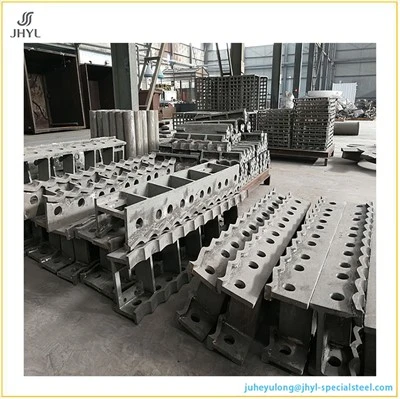
The cost-effectiveness of the High Manganese Steel Composite Hammer Head is widely recognized in crushing operations across mining, building materials, sand and gravel, metallurgy, and other industries. Especially under high-strength, high-wear, and heavy-impact working conditions, its comprehensive advantages are far superior to ordinary manganese steel hammers, high-chromium hammers, and common alloy hammers. Cost-effectiveness should not be judged by unit price alone, but also by service life, crushing efficiency, downtime losses, and overall operating costs. Measured against these dimensions, the High Manganese Steel Composite Hammer Head demonstrates outstanding cost-performance advantages.

First, the High Manganese Steel Composite Hammer Head features a composite structure consisting of a tough matrix and a high-hardness wear-resistant layer. It retains the excellent impact resistance and crack resistance of manganese steel, while integrating a super wear-resistant layer on the working surface, achieving both high impact resistance and superior wear resistance. Ordinary hammers either wear out quickly with short service lives and require frequent replacement, or are too brittle and prone to breaking under impact, causing equipment damage. The composite hammer head greatly reduces the three common failure modes: fracture, chipping, and excessive wear. Its service life is usually 2–3 times that of ordinary manganese steel hammers, directly lowering replacement frequency and labor costs.
Second, cost-effectiveness is reflected in a significant reduction in long-term operating costs. Many users focus only on the one-time purchase price while ignoring hidden costs such as downtime for parts replacement, production losses, and labor for disassembly and assembly. The longer service life of the High Manganese Steel Composite Hammer Head enables continuous and stable operation, reducing issues caused by hammer wear such as uneven discharge, reduced output, and current fluctuations. This results in higher production line efficiency and more stable operation. With the same output, hammer consumption and replacement frequency are lower, significantly reducing the comprehensive crushing cost per ton of material. It is more economical in long-term use than low-cost ordinary hammers.
Third, it offers strong adaptability to various working conditions, stably handling hard materials, wet materials, sticky materials, and mixed materials without rapid performance degradation due to changes in material type. Once installed on a crusher, it can operate stably for a long time without frequent adjustment or replacement. Its high versatility further improves operational efficiency and cost-effectiveness. Many mining and sand-gravel plants have reported obvious reductions in overall costs, more stable output, and faster payback periods.
Fourth, the High Manganese Steel Composite Hammer Head provides affordable pricing while maintaining high performance. Compared with expensive pure high-chromium or hard alloy hammers, it has a moderate unit price yet achieves similar wear resistance, with better impact resistance and a lower risk of sudden failure that could cause greater losses. The combination of moderate purchase cost, long service life, high efficiency, and low failure rate creates exceptional cost-effectiveness.
In summary, the High Manganese Steel Composite Hammer Head is highly cost-effective, particularly suitable for users pursuing stability, efficiency, and low operating costs. It is not the cheapest hammer head, but the best choice with the lowest unit cost and optimal overall benefits, truly helping users reduce costs, improve efficiency, and increase profitability. It is an outstandingly cost-effective option for crushing equipment accessories.