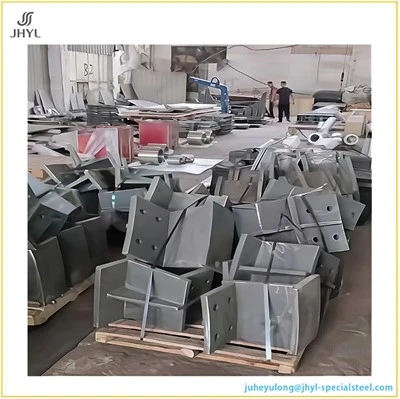
High-chromium Alloy Clad Hammer Head does not produce large volumes of extra dust during operation. Its overall dust emission is lower than that of traditional hammer heads. Operational dust is merely conventional dust naturally generated from material crushing, without incremental pollutants such as metallic wear dust or dust caused by over-crushing. It ranks among the preferred components for environmentally friendly crushing production lines. Many users mistakenly believe crushing hammer heads directly create heavy dust. In fact, dust generation primarily depends on crushing mode, post-crushing material particle size, and the wear and peeling status of hammer heads. This hammer head demonstrates prominent strengths across these three dimensions.
In terms of crushing principle, High-chromium Alloy Clad Hammer Head leverages high hardness and impact toughness to crush materials via constant-speed impact and extrusion. The crushing process is stable and controllable, without violent striking or repeated grinding of materials. Conventional ordinary hammer heads lack sufficient hardness and require multiple impacts to break materials. Repeated striking grinds materials into abundant fine powder and sharply raises dust concentration. By comparison, High-chromium Alloy Clad Hammer Head can complete material cracking in a single impact, simplifying the crushing workflow. Broken material particles are uniform, and the proportion of fine powder drops significantly, reducing dust generation at the operational source.
From the perspective of material wear, its core advantage lies in excellent wear resistance, erosion resistance and zero surface peeling. The high-chromium alloy wear-resistant layer reaches hardness above HRC60. It boasts outstanding wear and impact resistance. When crushing sand, ores, construction waste and other materials at high speed over extended periods, it will not shed surface material or wear down into debris, and produces no metallic dust impurities whatsoever. In contrast, ordinary carbon steel and low-alloy hammer heads easily wear and shed fragments during long-term operation. They not only generate metallic dust, but their worn irregular working surfaces also worsen material over-crushing and indirectly increase dust emissions.
According to comparisons in practical working scenarios, under identical equipment, material and output conditions, production lines fitted with High-chromium Alloy Clad Hammer Head show obviously lower floating dust concentration on site. Especially in medium and fine crushing operations, its precise crushing force can properly control material particle size and reduce the formation of micron-sized dust. In dry crushing scenarios, standard bag dust collectors or spray dust suppression devices can easily bring fine dust within environmental emission standards, with no need to add extra dust reduction equipment. Dust suppression performs even better in wet crushing, with almost no obvious flying dust within the working zone.
Overall, incremental dust produced by this hammer head is nearly negligible. Dust generation is simply a natural outcome of material crushing, and secondary dust is reduced thanks to optimized crushing results. Its features of zero self-generated dust and low dust output during crushing can improve the working environment, reduce abrasion and contamination of equipment frames, motors and bearings caused by dust, and lower risks of environmental rectification. It suits various working scenarios with dust control requirements in mining, building materials, infrastructure and other industries.