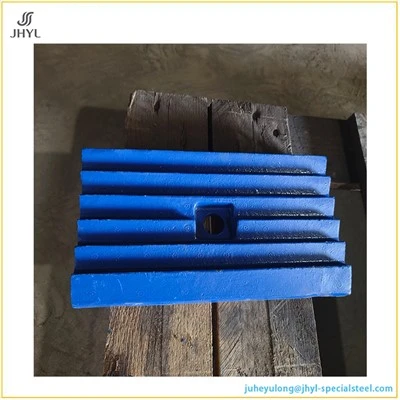
The wear resistance of Wear-Resistant High Manganese Steel Crusher Parts is not a fixed index. Its core value lies in the adaptive wear-resistant property brought by dynamic work hardening. To achieve ultimate wear-resistant advantages, extend service life and improve service performance to the fullest extent, no complicated operations are required. Only by matching its material characteristics, standardizing daily working condition operation and optimizing service modes can wear-resistant potential be maximized and durability advantages superior to ordinary spare parts be fully realized.
First and foremost, avoid prolonged no-load and light-load operation and maintain moderate material impact loads. The wear resistance of high manganese steel relies on impact and extrusion to trigger work hardening. Long-time idle running without material impacts prevents surface hardening and reinforcement. Components remain under low initial hardness with impaired wear resistance and unnecessary accelerated abrasion. In daily production, equipment should run with feed materials to ensure continuous uniform impact and extrusion on components from materials, sustain activation of surface hardening reactions and achieve continuous improvement of wear resistance. This constitutes the core prerequisite to leverage its wear-resistant advantages.
Secondly, maintain consistent and uniform feeding to realize even hardening and even wear of components. Unstable feeding volume or unilateral biased feeding in many production lines causes partial stress and partial impacts on crushing parts. It leads to excessive hardening and severe wear on one side, resulting in uneven component consumption and premature scrapping of spare parts due to local damage, which wastes overall wear-resistant capacity. During operation, continuous, even and centered feeding should be guaranteed so that the whole crushing surface evenly contacts materials and bears impact loads. Synchronous hardening and consumption over the entire surface maximize utilization of wear-resistant performance of the whole working face and prevent premature scrappage caused by excessive local wear.


Thirdly, refrain from unauthorized over-limit operation and protect stable formation of hardened layers. Stable working condition environments are required for hardened layer formation on high manganese steel surfaces. Long-term overload operation or frequent feeding of oversized foreign objects and ultra-hard materials generates excessive instantaneous impact loads, causing peeling and spalling of surface hardened layers, damaging formed wear-resistant layers and greatly weakening wear-resistant effects. Production should match appropriate material specifications and operating loads, avoid overloading under extreme working conditions, support stable generation and continuous reinforcement of hardened layers and preserve wear-resistant performance of components.
Fourthly, keep equipment operating smoothly and reduce abnormal frictional losses. Looseness, offset and jamming of equipment trigger abnormal friction, uneven wear and abnormal collision of crushing parts, creating invalid loss that offsets inherent wear-resistant advantages of the material. Basic regular inspection ensures stable equipment operation, allowing Wear-Resistant High Manganese Steel Crusher Parts to receive only normal material impact and crushing friction, fully exert inherent dynamic wear-resistant properties and eliminate ineffective abrasion.
In general, the core principle to maximize wear resistance of Wear-Resistant High Manganese Steel Crusher Parts is "match material characteristics, standardize working conditions and realize even operation". Through rational operation modes, the dynamic work-hardening property of high manganese steel can function continuously and steadily. Its ultimate wear-resistant and anti-impact strengths can be fully unlocked to extend component replacement cycles, maximize service value of Wear-Resistant High Manganese Steel Crusher Parts and help enterprises lower production costs and stabilize operation.