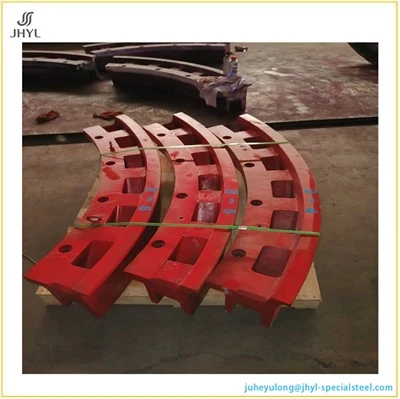
High-chromium Alloy Clad Hammer Head can efficiently address the industry pain point of material over-crushing, drastically cutting fine powder and waste dust, and improving particle integrity, particle size uniformity and utilization rate of finished materials. It serves as a core component to optimize finished crushing quality and reduce material loss, and has been widely used in sand and aggregate production, ore crushing, construction waste treatment and other production lines with strict requirements for finished particle size. Material over-crushing is a common problem in traditional crushing operations. It describes a scenario where materials of qualified particle size are repeatedly struck and ground into fine powder waste. This not only lowers finished product yield but also increases dust pollution and material loss. This hammer head thoroughly avoids this problem in terms of structure, material and crushing principle.
To start with, a stable working surface is the core foundation to prevent over-crushing. Traditional high manganese steel and ordinary alloy hammer heads have poor wear resistance. Wear, gaps, deformation, burrs and other defects appear after short operating durations. Damaged working surfaces cannot impact materials accurately and tend to scrape, grind and repeatedly strike materials. Materials already meeting particle size specifications will undergo secondary and multiple crushing, generating large volumes of waste powder. By contrast, the high-chromium alloy wear-resistant layer of High-chromium Alloy Clad Hammer Head delivers outstanding wear and erosion resistance. Its working surface remains flat, regular and clearly contoured after long-term operation. Crushing contact points are precise, targeting only large material blocks without secondary damage to materials that already meet qualified specifications.
Secondly, its scientific crushing principle prevents ineffective grinding. Boasting high hardness and strong impact strength, this hammer head uses a "one-shot impact cracking" crushing mode with concentrated impact force and high crushing efficiency. Large material blocks can complete cracking and forming in a single strike with no need for multiple impacts. Conventional hammer heads lack hardness and impact strength and cannot fully break materials in one strike, requiring repeated striking and extrusion. This process continuously grinds materials and causes severe over-crushing. The precise impact force of High-chromium Alloy Clad Hammer Head can accurately control crushing particle size, enabling graded material crushing and sharply lowering fine powder rate while enhancing the regularity of finished aggregate particles.
Furthermore, balanced counterweight and stable operating conditions optimize crushing results. The hammer head features high dynamic balance accuracy. It operates at a steady rotational speed with uniform impact force during high-speed rotation. There is no fluctuation in striking force, so crushing force can be well controlled to perform crushing according to particle size standards set by the equipment. It eliminates over-crushing caused by uneven force from an operational perspective. Meanwhile, its hardness and toughness are reasonably matched. No hammer head bouncing or slipping occurs during crushing, preventing repeated friction and crushing of materials triggered by bouncing and slipping.
In terms of practical production benefits, after switching to High-chromium Alloy Clad Hammer Head, the fine powder proportion of materials on production lines can drop by 10% to 20%. The output of qualified finished aggregate rises markedly, and material utilization improves greatly to reduce raw material waste. At the same time, reduced over-crushing cuts operational dust synchronously and lowers the probability of equipment blockage and chamber sticking faults. It effectively lifts production line efficiency and finished product quality. It is especially suitable for manufactured sand and stone processing scenarios with strict requirements on finished particle gradation, delivering multiple benefits of quality improvement, efficiency gain and cost reduction.