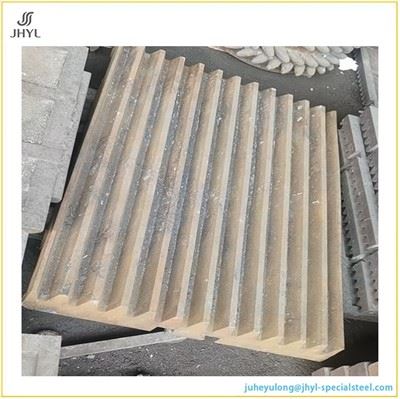
The wear resistance of a High Manganese Steel Jaw Plate is mainly related to the work-hardening characteristics and toughness of the material, as well as the actual operating environment. As an important wear-resistant component in a jaw crusher, the plate continuously contacts rocks, ores, and other materials while being subjected to impact, compression, and abrasive friction. Its ability to resist these forces directly affects the rate of wear and its service life.
First, work hardening is a major contributor to the wear resistance of high manganese steel. When high manganese steel is subjected to suitable mechanical impact and plastic deformation, changes can occur in its surface structure, gradually increasing local hardness. During jaw crusher operation, materials repeatedly enter the crushing chamber, where the movable and fixed jaw plates compress them against each other. As a result, the jaw plate surface experiences repeated mechanical stress. Under suitable operating conditions, these forces can gradually harden the surface layer, improving its resistance to abrasive cutting and frictional wear.
Second, the toughness of high manganese steel is equally important to its wear performance. Crushing operations generate not only surface wear but also potentially significant instantaneous impact loads. If a material has high hardness but insufficient toughness, it may develop cracks, chip, or suffer other forms of damage under impact. High manganese steel, when properly processed and heat-treated, can combine a degree of toughness with work-hardening capability. This allows the jaw plate to withstand impact while gradually developing a more wear-resistant working surface.
The wear performance of a High Manganese Steel Jaw Plate also depends heavily on operating conditions. Work hardening requires an appropriate level of mechanical action. If the jaw plate experiences insufficient impact, the surface may not harden adequately, preventing the material from fully demonstrating its wear-resistant potential. Conversely, prolonged exposure to abnormal impacts or excessive loads may cause localized damage. High manganese steel therefore does not provide the same wear-resistance advantages under every operating condition. Its properties must be compatible with the actual crushing application.
The characteristics of the feed material also influence how the jaw plate wears. The hardness, mineral composition, particle shape, and abrasiveness of rocks and ores can all affect the degree of surface wear. For example, highly abrasive materials may accelerate wear on the working surface, while the impact generated by large pieces can influence the work-hardening process. Understanding the characteristics of the feed material helps users select a suitable jaw plate material.
Heat treatment is another important factor affecting the performance of a High Manganese Steel Jaw Plate. Appropriate heat treatment helps establish the intended material structure and mechanical properties. If the material is not processed correctly, the jaw plate may not fully demonstrate its toughness and work-hardening advantages. Material control and heat treatment quality during manufacturing can therefore affect performance in actual operating conditions.
Jaw plate installation and equipment operation also influence wear uniformity. If the plate is not securely installed, loads are unevenly distributed, or the crusher operates under unsuitable conditions for extended periods, certain areas may wear more quickly than others. Correct installation, appropriate feeding practices, and regular inspections help reduce uneven wear and improve practical service performance.
In summary, a High Manganese Steel Jaw Plate primarily achieves wear resistance through work hardening, which increases the hardness of its surface layer, while its toughness helps it withstand impact loads during crushing. Its wear performance is not determined by the material name alone; it also depends on material condition, feed characteristics, equipment operation, and maintenance practices. Proper selection and use allow the jaw plate to deliver its intended wear-resistant benefits more effectively.