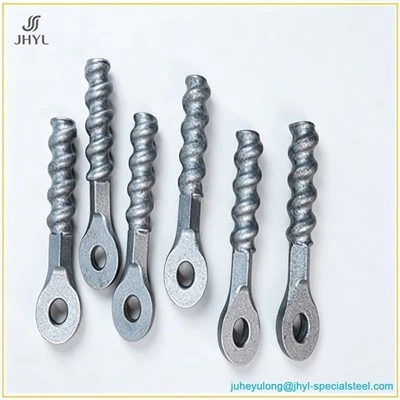
The production process for Fast Forging Components is characterised by complex parameter tuning in early phases, standardised workflows in intermediate phases and rigorous quality‑control protocols in later phases. It is moderately complex. Distinct from simple conventional forging and ultra‑high‑threshold special‑precision machining, it constitutes a set of standardised, closed‑loop, high‑precision industrial‑forming technology suitable for mass‑volume production and high‑end precision‑component manufacturing. Its complexity mainly originates from precise parameter governance and full‑process precision management rather than cumbersome working steps. The complete fast‑forging production workflow is clear and standardised, consisting of seven core stages: raw‑material inspection and pretreatment, precise constant‑temperature heating, blank pre‑shaping, high‑speed precision‑forging forming, residual‑heat straightening, quenching‑and‑tempering heat treatment, precision finishing and non‑destructive quality inspection. Closely interlinked procedures enforce strict parameter standards at every stage, which forms the principal source of its process complexity.
The primary complexity‑driving challenge resides in accurate temperature control. Fast forging applies to multiple special‑alloy materials whose plastic‑forming temperature windows are extremely narrow. Temperature fluctuation exceeding ±10 ℃ will induce forming defects and sub‑standard mechanical properties. Intelligent temperature‑controlled heating equipment is deployed for sectional constant‑temperature blank heating to guarantee uniform blank bulk temperature while avoiding over‑burning, oxidation and decarburisation. High‑grade temperature‑control precision forms the foundation for qualified forgings and represents a core process‑governance difficulty. Next comes coordinated multi‑parameter control during forming. Special fast‑forging units are deployed for fast forging, requiring accurate matching of multiple variables: forging speed, forging force, forging frequency and holding time. Parameters differ completely for materials and components of varying specifications. Mismatched parameters directly trigger component deformation, dimensional deviation, uneven internal grain structures and excessive residual stress. Digital control systems are required for precise regulation, setting high benchmarks for equipment intelligence and process‑debugging capabilities.
Furthermore, fast forging demands strict matching between blank pretreatment and subsequent heat‑treatment cycles. Raw materials undergo pre‑emptive flaw detection, rust removal and homogenisation treatment to screen out defective blanks and stop defects from entering forming stages. After forming, blanks receive preliminary straightening using residual heat, followed by heat‑treatment routines such as normalising and quenching‑and‑tempering to eliminate forging‑induced residual stress, further refine grains and stabilise component performance. Temperature, holding duration and cooling rates for heat treatment must precisely align with forging‑process parameters. Otherwise defects such as uneven hardness, deformation spring‑back and unsatisfactory fatigue performance will emerge. The full workflow possesses strong linkage and systematic characteristics.
Even so, this is not a niche high‑barrier technology. Complexity concentrates on early‑stage process debugging, parameter finalisation and equipment calibration. Once standardised‑parameter systems are established, mass‑production workflows become highly standardised and automated with minimal manual intervention, high fault tolerance and stable output. Compared with processes such as precision casting, powder metallurgy and special welding, fast forging delivers simpler workflows, stronger controllability and higher yield rates. To summarise, fast forging is defined by complex debugging, straightforward mass‑production execution, strict precision specifications and high standardisation. It suits large‑scale stable industrial manufacturing and acts as a high‑quality forming technology balancing precision, quality and production capacity.