

PROCESS Lost Foam (LFC) PART TYPE Heat-Resistant Steel Plate TOLERANCE CT7–CT9 · ISO 8062 SERVICE 850–1150°C
Flatness is a process decision, not a machining decision.
Heat-resistant hearth plates and furnace tooling do not fail from insufficient strength. They fail from distortion - warping, loss of flatness and scale-driven section loss under sustained thermal load. This page sets out how the lost foam process controls that dimensional chain from foam pattern to final service plate, and where the process stops being the right answer.
Dimensional tol.
CT7–CT9
ISO 8062
As-cast surface
Ra 6.3–12.5 μmno parting line
Part weight
1 – 500 kgplate geometry
Min. wall
~3 mmgeometry dependent
Default grade
1.4848 / HK40
25Cr-20Ni austenitic
Six stages determine the flatness of a heat-resistant plate
A plate's final flatness is not set at the machining centre. It is accumulated across six stages, from foam density to the release of residual stress in service. Lost foam intervenes at stages 1, 2 and 5; the rest are controlled by grade selection and process discipline.
Foam pattern
EPS density (20–25 kg/m³ for steel) governs uniform shrinkage across the plate.
Refractory coating
Coating thickness (0.5–1.5 mm) sets as-cast surface and dimensional consistency.
Pouring & solidification
Pouring temperature and feeding set thermal stress distribution through the plate.
As-cast plate
Baseline dimensions established at CT7–CT9 with no parting-line discontinuity.
Machining allowance
Reduced stock removal means less residual stress introduced into the working face.
Service
Residual stress releases at temperature. Final flatness is the accumulated result.
Where lost foam sits, and where it does not
A process page is only useful if it states the trade-offs. The two comparisons below are the ones that matter for heat-resistant plate geometry.
Lost foam vs. conventional sand casting
Conventional sand casting has a parting plane. On large-area plates that plane is where flash, dimensional step and cooling stress concentrate. Lost foam has no parting line, and its tolerance and surface are tighter, which directly reduces the stock that has to be machined off the working face.
- No parting line - no flash or step across the load-bearing face
- CT7–CT9 against wider sand-cast tolerance bands
- As-cast Ra 6.3–12.5 μm - less face machining, less introduced stress
- Integral ribs and slots cast without cores
Lost foam vs. investment casting
Investment casting offers tighter tolerance and finer surface, but pattern and shell cost rise steeply with part size. For heat-resistant plates in the tens-to-hundreds of kilograms range, lost foam provides a more favourable balance of near-net shape, tooling cost and lead time.
- Lower pattern cost than wax pattern plus ceramic shell
- Better suited to plate sizes above investment casting's economic range
- Shorter tooling-to-first-article cycle for medium and large plates
- Surface and tolerance adequate for most hearth plate duties.
Lost foam capability, stated as numbers
Representative values from our lost foam line. Actual capability is confirmed per drawing during review; the table below is the baseline we quote against.
Process capability |
|
| Parameter | Value |
| Dimensional tolerance | CT7 – CT9 |
| As-cast surface roughness | Ra 6.3 – 12.5 μm |
| Typical part weight | 1 – 500 kg |
| Minimum wall / feature | ~3 mm |
| Foam density (steel) | 20 – 25 kg/m³ |
| Coating thickness | 0.5 – 1.5 mm |
| Pouring temperature | 1,520 – 1,620°C |
| Pattern source | Drawing / 3D / sample |
Documentation per batch |
|
| Document | Scope |
| Chemical composition | Per heat |
| Mechanical properties | Per batch |
| Dimensional report | Vs. agreed drawing |
| First-article report | On new tooling |
| ISO 9001:2015 | System certificate |
| Third-party inspection | SGS / BV / TÜV on request |
Typical plate duties
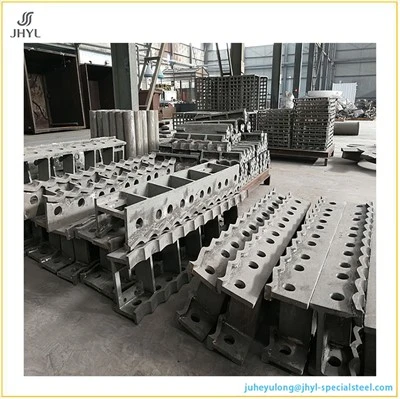
Load-bearing bottoms for annealing, hardening and tempering furnaces; flat working face with integral support ribs.
Furnace tray bases and fixture plates requiring dimensional stability under repeated thermal cycling.
High-temperature contact surfaces where scale resistance and flatness affect workpiece quality.
Heat-resistant plate sections exposed to ash, thermal cycling and oxidizing flue gas.
High-temperature structural plates and baffle components in process equipment.
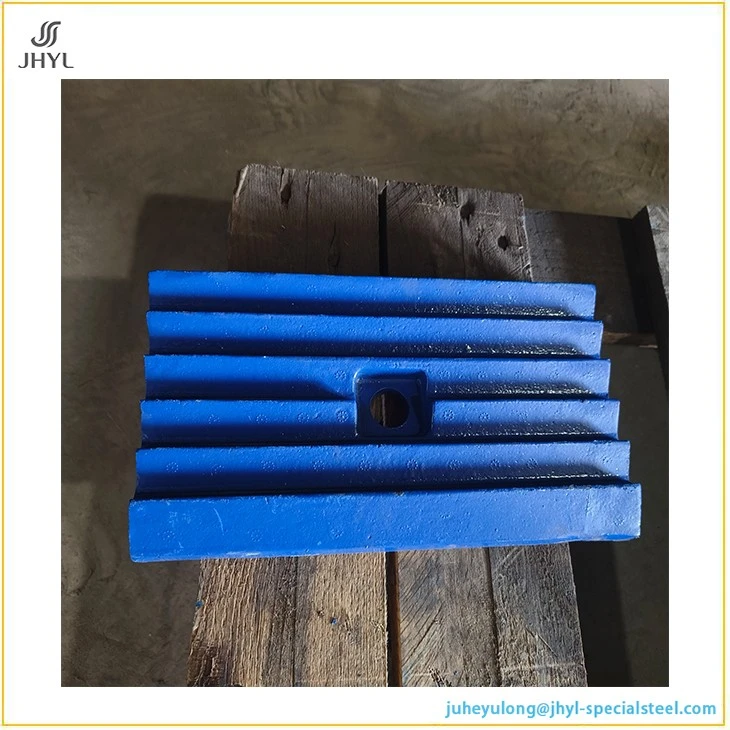
Application-specific heat-resistant plates with integral bosses, slots or rib patterns.
Where lost foam is the wrong answer
These are the boundaries we apply during drawing review. If your part falls outside them, we will say so before quoting.
|
|
Carbon content below ~0.1%Very low carbon steels are generally not suitable for the lost foam process. Heat-resistant plate grades sit well above this threshold. |
|
|
Tolerances tighter than CT7If the drawing requires tolerance beyond the CT7–CT9 band on as-cast features, CNC machining or a different casting process should be considered. |
|
|
As-cast surface finer than Ra 6.3 μmLost foam delivers a good sand-cast surface, not investment-cast finish. Surfaces requiring Ra below 6.3 μm are machined. |
|
|
Single replacement platePattern cost is most economic across a repeat batch. For a one-off plate we will advise whether lost foam or an alternative route is more practical. |
 |
Integral ribs, bosses and slotsThese are exactly the features lost foam casts well - through the foam pattern, without cores or welded assembly. |

Frequently Asked Questions
Why choose lost foam over sand casting for a heat-resistant plate?
-
The process-level advantages that matter for plate geometry are the absence of a parting line, tighter dimensional tolerance (CT7–CT9) and a better as-cast surface - which together reduce machining allowance on the working face. On heat-resistant plates, less face machining means lower risk of machining-induced flatness deviation in service. Integral ribs and slots can also be cast without cores.
Which grade should we specify for our hearth plate?
-
1.4848 (HK40) is the most widely used general-purpose grade for 850–1050°C oxidizing furnace plate duty. If the plate sees higher temperature, carburizing or sulphidizing atmosphere, or a specific load case, 1.4776 (GX40CrSi28) or another EN 10295 grade may be more appropriate. Send the metal temperature, atmosphere and load with your drawing and we will confirm the grade before quoting.
Can you cast the plate with integral ribs and slots?
-
Yes. Lost foam casts features directly through the foam pattern, so backside ribs, locating bosses and gas-flow slots can be integral to the plate without separate cores or welded assembly. Send a 2D drawing or 3D model and we will review castability, draft and minimum wall thickness.
What is the minimum order quantity and lead time?
-
Lost foam is most economic across a repeat batch rather than a single piece. Typical trial quantities are modest, and production lead time runs several weeks after tooling and first-article approval. Exact MOQ and schedule depend on plate size, weight and pattern complexity - confirmed during quotation.
What documentation comes with a batch?
-
Each heat is supplied with a chemical composition record and mechanical property data. Dimensional verification against the agreed drawing or first-article report is provided, and third-party inspection (SGS, BV, TÜV) can be arranged on request.
Hot Tags: lost foam casting of high-temperature-resistant cast steel plate, China lost foam casting of high-temperature-resistant cast steel plate manufacturers, suppliers, factory, 310S Vacuum Furnace Charging Basket, boiler sections, heat resistant steel casting parts, parts in a boiler, parts of a boiler, system boiler components