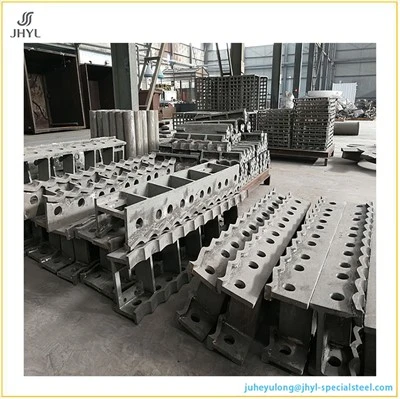
Austenitic Heat Resistant Cast Steel
Cast Heat Resistant Steel Heat Treatment Baskets
1.4848 · HK40 · Cr25Ni20 · 1.4849 · 2.4879
One-piece cast construction. No welds to fail. Built to survive the cycles that destroy fabricated baskets.
- 1.4848 / HK40
- Cr25Ni20
- 1.4849
- 2.4879
- 310S
|
1100°C Max Continuous Service |
500–2000 kg Load Capacity |
3–5× Life vs. Welded Baskets |
Spectrometer Verified Chemistry UT / PT on Critical Sections MTC with Every Shipment Reply Within 24 Hours
Why Heat Treatment Baskets Fail Early
In high-temperature furnace service, baskets are exposed to thermal cycling, carburizing atmospheres, and mechanical load - simultaneously. The failure modes are predictable, and so are the solutions.
Weld Joint Failure
Welded baskets fail at the weld line. Under repeated heating past 1000°C and rapid cooling, the weld and heat-affected zone concentrate thermal stress and become the first crack initiation site. A one-piece cast structure eliminates this failure point entirely.
Creep Distortion
Under sustained load at high temperature, alloy components progressively sag and deform. This is the most common cause of basket failure in carburizing conditions. High-carbon cast alloys resist creep significantly better than wrought or low-carbon grades.
Carburization & Metal Dusting
In carburizing atmospheres, carbon penetrates the alloy surface, embrittling the material and eventually causing spalling and cracks. High-silicon alloys like 1.4848 and 1.4849 are specifically designed to resist carbon penetration.
Alloy Grade Selection
Five standard grades, plus custom chemistry. The right choice depends on peak temperature, atmosphere, load, and thermal cycling frequency.
| Grade | Typical Chemistry (C / Cr / Ni / Si) | Max Continuous Temp. | Best For |
|---|---|---|---|
| 1.4848 / HK40 | C 0.35–0.45%, Cr 24–27%, Ni 19–22%, Si 1.5–2.5% | 1100°C | Carburizing, quenching, general heat treatment, heavy loads |
| Cr25Ni20 | C 0.30–0.50%, Cr 23–27%, Ni 19–22%, Si ≤1.75% | 1050–1100°C | General-purpose base trays, annealing, racks |
| 1.4849 | C 0.30–0.50%, Cr 24–26%, Ni 11–14%, Si 1.0–2.5% | 1100–1150°C | Heavy loads, long cycles, aggressive carburizing, thermal shock |
| 2.4879 | Ni-base with Cr, Si additions | 1200°C | Vacuum furnaces, low outgassing, vacuum brazing |
| 310S | C ≤0.08%, Cr 24–26%, Ni 19–22% | 950°C | General carburizing, moderate loads, budget-conscious |
Selection tip: If your furnace runs above 950°C, carries loads over 300 kg, or operates on a continuous cycle with frequent thermal shock, a cast basket is almost always the better choice over a welded or wire mesh basket. The higher upfront cost is offset by 3–5× longer service life and lower cost per cycle.
Cast vs. Welded: Why One-Piece Construction Matters
The manufacturing method determines where the basket will fail - and how soon.
Recommended
One-Piece Cast Basket
- No weld joints - eliminates the #1 failure point in furnace fixtures
- 3–5× longer life under identical thermal cycling conditions at 1050°C
- Higher load capacity - 7–10% more than frame-welded designs due to thinner wall cross-sections
- Better creep resistance - high-carbon cast alloy resists sagging under sustained load
- Precision cast to CT8–CT10 - consistent dimensions for automated loading systems
- Single continuous structure distributes thermal stress smoothly
Alternative
Welded / Fabricated Basket
- Lower upfront cost - suitable for moderate temperature, light-duty applications
- Weld zones vulnerable to thermal fatigue and cracking under repeated cycling
- Limited load capacity - concentrated loads can cause local deformation
- More frequent replacement - weld cracks propagate faster at high temperature
- Easier field repair - re-weld cracked joints or replace sections
- Better for small quantities - no pattern cost, faster lead time.
From Drawing to Finished Basket
Five controlled steps. Every step has an inspection point before the next one begins.
Pattern & Molding
Wood or metal pattern made to your drawing or furnace model. Controlled sand compaction to avoid mold shift and dimensional drift.
01
Melting & Pouring
Medium-frequency induction furnace. Chemistry verified by spectrometer before tapping. Pouring temperature logged per heat.
02
Solution Treatment
Heated to 1140–1160°C for uniform austenitization, then rapidly cooled. This eliminates casting residual stress and maximizes high-temperature creep resistance.
03
Machining & Finishing
Critical mating surfaces, lifting lugs, and mounting points machined to drawing tolerance. Optional sand blasting or anti-oxidation coating.
04
Inspection & Dispatch
UT or PT on critical sections, dimensional report, MTC issued. Certificates ship with every basket.
05
Furnace Compatibility
Different furnace types impose different heat paths and atmosphere chemistry. We match the design to your furnace, not the other way around.
Carburizing Furnace
High-silicon alloys resist carbon penetration. Anti-carburization design for rich atmosphere zones.
Vacuum Furnace
Low outgassing, non-contaminating surfaces. 2.4879 or Inconel alloys for vacuum brazing and hardening.
Pit / Well Furnace
Vertical load stability, deep geometry. Rigid flat-bottom support for heavy charge stacks.
Roller Hearth Furnace
Smooth bottom runners, flat base for stable tracking. Customized runner spacing to your roller pitch.
Request a Quote
| MOQ | 2 pieces (trial order negotiable) |
| Customization | Cast to drawing / sample / furnace model |
| Lead Time | 25–50 working days |
| Packaging | Plywood wooden case, seaworthy packing |
| Shipping | Sea / Air / Express - FOB, CIF, DDP available |
| Payment Terms | T/T, L/C - negotiable for repeat orders |
| Warranty | Guaranteed against casting defects and dimensional non-conformance |
Frequently Asked Questions
What is the difference between cast and welded heat treatment baskets?
-
Cast baskets are produced as a one-piece structure without welded joints. Welds are the first point of failure in furnace fixtures because they concentrate thermal stress under repeated heating and cooling. A precision cast basket can last 3–5 times longer than a welded fabricated basket under identical thermal cycling conditions at 1050°C.
Which alloy grade should I choose for my furnace?
-
The right grade depends on peak temperature, atmosphere and load. 1.4848 (HK40) is the workhorse for carburizing and general heat treatment up to 1100°C. 1.4849 offers improved oxidation resistance for frequent door openings and thermal shock up to 1150°C. 2.4879 is specified for vacuum furnaces requiring low outgassing. 310S is a cost-effective option for general carburizing up to 950°C with moderate loads.
What load capacity can you build?
-
Standard cast baskets range from 500 kg to 2000 kg load capacity, depending on geometry, alloy grade and furnace type. Heavy-duty designs can be engineered for specific charge weights. We recommend a charge-to-weight ratio that leaves at least 30% safety margin above your maximum load.
Can you cast baskets to match my existing furnace fixtures?
-
Yes. We produce to your drawings, sample or furnace model. We work with common furnace brands including IPSEN, AICHELIN, AFC, ECM and BMI. If you don't have a drawing, send us the furnace make and model plus load requirements, and we will confirm dimensions before casting.
What testing and documentation do you provide?
-
Every heat is tested for chemical composition by spectrometer. We perform visual inspection 100%, dimensional check, and UT or PT on critical sections. A Material Test Certificate (MTC) is issued with every shipment. Third-party inspection is welcome.
Hot Tags: cast heat resistant steel heat treatment baskets, China cast heat resistant steel heat treatment baskets manufacturers, suppliers, factory, 310S Vacuum Furnace Charging Basket, coal boiler parts, heat resistant steel casting parts, Integrally Cast Annealing Process Furnace Frame, parts in a boiler, system boiler components