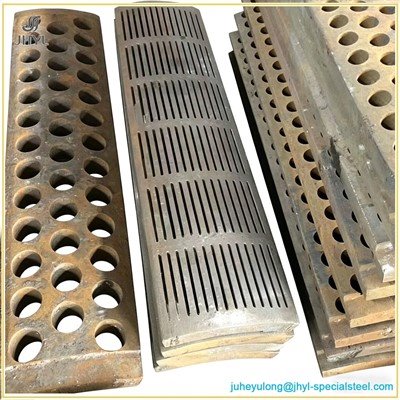
If you've ever stood next to a large ball mill during a liner replacement, you know it's not just a maintenance task-it's a battle against heavy components, tight timelines, and the kind of precision that can make or break a mine or processing plant's whole shift. As a ball mill liners supplier, I've spent years on site with maintenance crews, watching them sweat through challenges that aren't always obvious in spec sheets or sales manuals. Large-sized ball mill liners, the ones that cover the inside of mills 18 feet and up in diameter, come with a unique set of installation difficulties that even experienced teams can stumble on. Today I want to break down those pain points, share what I've learned from working with plants across North America, and explain how partnering with the right supplier can take a lot of the stress out of the job.
First off, there's the sheer weight and bulk of these liners. A single large ball mill liner, designed to hold up to 10,000+ tons of ore per hour, can weigh anywhere from 1,500 to 4,000 pounds each-some even heavier for the biggest SAG mills (semi-autogenous grinding mills) used in copper and gold processing. When you're working with 50 to 80 liners per mill, that adds up to hundreds of thousands of pounds of metal to move in a confined space. I saw this first hand last year at a gold mine in Nevada where their usual installation crane went down for emergency repairs mid-project. The crew tried to use a smaller auxiliary crane to lift the 3,800-pound lifter liner, and it ended up swinging off-balance, nearly hitting a worker before they could lock it down. It's not just about lifting the liner-it's about positioning it perfectly 12 to 15 feet above the mill's interior, where a single misalignment can mean hours of readjustment. Smaller, standard liners are easy to carry by two people, but large-sized ones require specialized lifting equipment, and even that doesn't eliminate the risk of human error when guiding them into place.
On top of weight, there's the complexity of mill design that throws liners off. Most modern large ball mills have a curved interior shell, and large liners are often custom-shaped to match that curve-except when they don't. I've heard stories from maintenance teams where they received liners that fit the mill spec on paper but had micro-castings in the metal that made one edge sit ¼ inch higher than the rest. For a small liner, ¼ inch might not matter, but over a 10-foot span of a large mill, that gap can cause liner shift, uneven wear, and even liner failure after just a few weeks of operation. This is where the material your liners are made from matters too. Many plants still rely on high manganese steel for its toughness, but even high manganese steel crusher parts (link: /mining-machinery-parts/crusher-components/high-manganese-steel-crusher-parts.html) come with casting tolerances that can be tricky to work with when you're talking about large, precision-fit liners. Unlike smaller crusher parts that can be machined to exact specs after casting, a large ball mill liner can't easily be shaved down on site without specialized machining equipment, which most mines don't keep on hand for maintenance.
Another big installation headache is the alignment and bolt torqueing process that comes after positioning. Large ball mill liners aren't just sitting on the shell-they're held in place by dozens of high-tensile bolts that have to be torqued to a very specific range, usually between 2,500 and 4,000 ft-lbs, depending on the mill size. The problem? When you're working in the dark, dusty environment of a mill bay, it's almost impossible to get a consistent torque reading on every bolt. I've had a crew tell me they spent three extra hours replacing three bolts that were under-torqued, because they only realized after a test run that those bolts had shifted during the mill's first rotation. Over-torquing is just as bad-it can stretch the bolts beyond their limit or crack the liner's mounting flange, which is a costly mistake that can delay production by days. What makes this worse is that large liners often have to be installed in sections, not one at a time, so misalignment in one section throws off the next, creating a chain reaction of bolt fitting issues.
Heat and environment add another layer of difficulty that most people don't anticipate. If you're working in a mine in Canada during winter, temperatures can drop to -20°F, making metal brittle and tools hard to operate. Last winter, I was at a copper mine in British Columbia where their installation team was dealing with frozen bolt threads, which meant they had to spray each bolt with heated anti-seize and use a torch to warm the liner's mounting holes before they could even get a bolt started. On the flip side, working in desert mines in Arizona or Australia during summer, temperatures on the mill shell can hit 120°F by midday, making metal expansion a real concern. Large liners expand much more than small parts, so if you torque bolts when the liner is hot, it will cool down and shrink, leaving gaps between the liner and the mill shell. Install when it's cool, and the liner will expand when the mill heats up during operation, putting too much stress on the bolts. This is a fine balance, and it's one that even the most experienced crews struggle with when they're under pressure to meet a production deadline.
Wait, let's circle back to materials, because this is something I talk about constantly with my team and our clients. A lot of plants don't realize that the same material used for crusher parts can't always be swapped for ball mill liners. For example, KmTBCr15Mo high chromium cast iron fine crusher hammer (link: /mining-machinery-parts/crusher-components/kmtbcr15mo-high-chromium-cast-iron-fine.html) is great for impact resistance in crushers, but it's too brittle to handle the constant tumbling and shifting that large ball mill liners face. Similarly, high manganese steel crusher screen plate (link: /mining-machinery-parts/crusher-components/high-manganese-steel-crusher-screen-plate.html) has wear resistance for screening ore, but it doesn't have the impact toughness needed to line a mill that's processing 10,000 tons of ore an hour. When a plant uses the wrong material, not only does the liner wear out faster, but it also creates installation difficulties because the liner is less malleable, making it harder to adjust to small imperfections in the mill shell. My advice? Always match the liner material to the mill's load, ore type, and installation conditions-don't just go for the cheapest option.
Another hidden installation difficulty is lining the mill's discharge and feed ends, which are often more cramped than the main shell. Large liners for these ends are shorter and thicker, so they're even harder to maneuver in tight spaces, and they have to fit perfectly around the trunnion, the part of the mill shaft that the liner rotates on. I've seen crews spend a whole day just on the discharge end liner, because it wouldn't fit around the trunnion, and they had to use a hand grinder to shave a small section-only to realize later that the grinder marks would cause uneven wear on the liner. When you're working on a large scale, every small imperfection in the liner's fit adds up, and that's why pre-installation inspections are so important.

Let's not forget about downtime pressure, which makes every installation more difficult. Most mines and processing plants can only shut down their mills for a limited window, usually between 72 and 96 hours, between production campaigns. Installing large liners takes time-you have to remove the old liners, clean the mill shell, position the new liners, torque all the bolts, and do a test run. If there's a delay, like a liner that doesn't fit or a bolt that won't thread, the whole mill is offline, costing the plant thousands of dollars per hour in lost production. I've had a client tell me once that a 12-hour delay in liner installation cost them over $200,000-so the pressure to get it right the first time is immense, and that pressure amplifies every installation difficulty.
Now, the good news: these difficulties aren't unsolvable, and partnering with a reliable ball mill liners supplier can make a huge difference. For one thing, a good supplier will work with you to design custom liners that account for your specific mill's design, ore type, and installation environment. We work closely with our clients to get precise mill measurements before casting, which means fewer fit issues on site. We also offer a range of materials designed specifically for ball mill liners, not just crusher parts-so if you need impact resistance, we can recommend a high manganese steel liner that's engineered to handle tumbling loads, or if you have highly abrasive ore, we can suggest a high-chromium alloy that has the wear resistance without being too brittle.
Another thing a good supplier can provide is support on site. Our team has installation specialists who travel to plants to help with liner positioning, torqueing, and even training crews on how to handle large liners safely. We also stock replacement parts, like high-quality bolts and anti-seize, that are designed to work with our liners-so you don't have to scramble to find parts when you're mid-install. For example, when a plant in Peru had a problem with frozen bolts last year, we shipped heated anti-seize and a portable torque wrench to their site within 24 hours, which helped them get back on schedule without further delays.
If you're dealing with large-sized ball mill liner installation difficulties, you don't have to go at it alone. Whether you're tired of dealing with liners that don't fit, installation delays, or premature liner wear, we're here to help. Our team has decades of experience working with mining and processing plants across the globe, and we can provide custom liners, on-site support, and the materials you need to make your liner installation smooth and successful. Get in touch with us today to discuss your liner needs and find out how we can help solve your installation challenges.
References
- M. W. Ptak, "Ball Mill Liner Design and Installation Best Practices," International Journal of Mineral Processing, vol. 145, 2016, pp. 112-121.
- J. D. Gates, "Challenges in Large-Scale Grinding Mill Maintenance," Mining Engineering, vol. 69, no. 5, 2017, pp. 45-50.
- T. E. Nørgaard, "Material Selection for Ball Mill Liners: Balancing Wear Resistance and Toughness," Journal of Materials Engineering and Performance, vol. 28, no. 3, 2019, pp. 1456-1465.
- S. K. Biswas, "Crusher and Mill Liner Installation: Key Factors for Operational Efficiency," Minerals Engineering, vol. 152, 2020, pp. 106342.