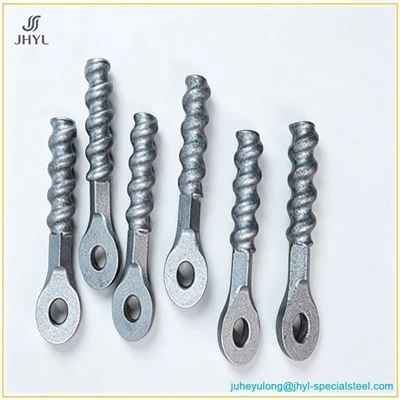
Superior operational stability represents a core advantage of Fast Forging Components. They satisfy the high‑frequency, continuous and high‑intensity operation requirements of industrial‑grade equipment and sustain stable performance, shape and running status throughout their full service cycles. As key parts that support stable long‑term operation of industrial machinery, they are widely adopted in machinery manufacturing, mining, metallurgy, heavy‑duty industries and other fields.
First of all, structural stability forms the foundation for reliable operation. Fast Forging Components are integrally forged without splicing, welding or bonding procedures. Their one‑piece integral structure eliminates common hidden risks of spliced components, including gap loosening, splicing misalignment and structural disconnection. Moreover, high‑speed forging modifies metal materials to produce fine, evenly distributed grains with continuous penetrating metal fibers. Strength, toughness and hardness stay consistent across the whole component without locally weak sections. This avoids local performance imbalance and structural damage during operation and guarantees stability from a physical‑structure perspective.
Secondly, dynamic operational performance remains steady. During equipment operation, components endure combined external forces including centrifugal force, friction, reciprocating impact and vibration stress. Ordinary parts often suffer stress accumulation and uneven force‑bearing, which bring vibration, offset, stalling and abnormal wear that impair overall equipment function. Fast Forging Components feature strong stress tolerance. Various external forces get evenly dispersed and rapidly dissipated without concentrated stress build‑up. They rotate without vibration or offset at high speeds and run reciprocally without stalling or blockage, maintaining smooth operation and preserving equipment‑running accuracy.
In addition, they excel in long‑term operational stability and fatigue resistance. Numerous industrial devices require round‑the‑clock continuous operation, which demands strong anti‑fatigue and anti‑degradation capabilities for components. Ordinary parts easily develop metal fatigue, performance decline and structural loosening after long‑time service, further triggering equipment malfunctions. Reinforced by forging treatment, Fast Forging Components obtain prominent anti‑fatigue properties. After long‑term high‑frequency and high‑load operation, they avoid performance degradation, grain relaxation and structural aging. Wear progresses uniformly and slowly, and initial operating states can be maintained for long periods without frequent maintenance and replacement.
Moreover, stability stays reliable under complex working conditions. Faced with high‑low‑temperature alternation, dust, humidity, slight corrosion and load fluctuations, Fast Forging Components will not experience sudden performance drops, structural damage or abnormal operation. Boasting balanced overall performance and strong environmental adaptability, they avoid vibration, efficiency loss and frequent failures brought on by environmental changes. In general, Fast Forging Components deliver outstanding stability across diverse scenarios and full service cycles. They improve overall equipment efficiency, cut downtime for maintenance and offer powerful support for continuous‑mode production.